AI for Business

Explore the best AI for Business — independent reviews, comparisons, pricing and step-by-step how-to guides, curated by Aizhi.

  • Process map

    Process map

    Process map is a global-system process model that is used to outline the processes that make up the business system and how they interact with each other. Process map shows the processes as objects, which means it is a static and non-algorithmic view of the processes. It should be differentiated from a detailed process model, which shows a dynamic and algorithmic view of the processes, usually known as a process flow diagram. There are different notation standards that can be used for modelling process maps, but the most notable ones are TOGAF Event Diagram, Eriksson-Penker notation, and ARIS Value Added Chain. == Global process models == Global characteristics of the business system are captured by global or system models. Global process models are presented using different methodologies and sometimes under different names. Most notably, they are named process map in Visual Paradigm and MMABP, value-added chain in ARIS, and process diagram in Eriksson-Penker notation – which can easily lead to the confusion with process flow (detailed process model). Global models are mainly object-oriented and present a static view of the business system; they do not describe dynamic aspects of processes. A process map shows the presence of processes and their mutual relationships. The requirement for the global perspective of the system as a supplementary to the internal process logic description results from the necessity of taking into consideration not only the internal process logic but also its significant surroundings. The algorithmic process model cannot take the place of this perspective since it represents the system model of the process. The detailed process model and the global process model represent different perspectives on the same business system, so these models must be mutually consistent. A macro process map represents the major processes required to deliver a product or service to the customer. These macro process maps can be further detailed in sub-diagrams. It is often the case that process maps cross different functional areas of the organization. Process maps are used by many companies to have a holistic view of all processes and the connections between them. Maps help in navigating the sub-processes and make understanding of the organization's operations easier. The process map shows relationships and dependencies between processes and its focus should be on core business processes of the organization. A process map can be seen as the most abstract level of the process architecture, and it acts as the introduction to the more detailed levels. A process map that is correctly designed is able to provide a general understanding of a company's operations. Designing the process map is an important and strategic step for the organization, and it is followed by further business process modelling implementation. == Context == Methodology for Modelling and Analysis of Business Process (MMABP) is a business process modelling methodology developed at the Department of Information Technology, Faculty of Informatics and Statistics of the Prague University of Economics and Business. The methodology is defined as a “general methodology for modelling business systems using informatics methods and approaches”. Methodology is used to analyse business processes and to develop a comprehensive model of the system. The goal of developing a model is to be used for process optimization. The model should be created following the characteristics and specifics of the organization in question and following external influences that can affect the organization. The model should be optimal from an economic perspective, but it should also be optimal from a factual perspective, meaning that it should be as simple as possible while maintaining complete functionality. Business system modelling is based on a two-dimensional approach: Real World structure (substance) – set of objects and their relationships Real World behaviour – set of mutually connected business processes Additionally, there are also two views of the systems: Global view of the system Detailed view of the system's parts This results in the need to model the system from four different perspectives in order to achieve the complete and comprehensive view of the business system. MMABP also proposes which notation languages can be used for modelling each perspective, and it also suggests some improvements to the notation languages in order to fit the purpose. Global view of the objects – Conceptual model (Class diagram) Detailed view of the objects – Object life cycle (State Chart) Global view of the processes – Process map (Eriksson-Penker Diagram/TOGAF Event Diagram/ARIS VAC) Detailed view of the processes – Model of the process flow (BPMN Diagram) Data Flow Diagram (DFD) is additional diagram used for describing the required functionalities of the information system. == Notation standards == === Eriksson-Penker Diagram === Eriksson-Penker diagram is a tool used in business model analysis and design. It is named after Hans-Erik Eriksson and Magnus Penker, who developed the concept in their book "Business modelling with UML: Business Patterns at Work”. Eriksson-Penker diagrams are used to map out the key components of a business model and how they interact with one another. The diagrams typically consist of a series of boxes and lines that represent the different elements of the business model, such as the value proposition, customer segments, channels, revenue streams, and key resources. The lines between the boxes represent the relationships and dependencies between the different elements of the business model. These diagrams are useful for visualizing and understanding the various components of a business model, and can help organizations identify potential areas for improvement or areas of risk. They can also be used as a communication tool to help stakeholders understand the business model and its underlying assumptions. These diagrams are useful for visualizing and understanding the various components of a business model, and can help organizations identify potential areas for improvement or areas of risk. They can also be used as a communication tool to help stakeholders understand the business model and its underlying assumptions. It is possible to use Eriksson-Penker diagrams to create a global process view of a business. In this case, a diagram would be used to map out the key processes and activities that are involved in the business, as well as the relationships and dependencies between these processes. For example, an Eriksson-Penker diagram could be used to depict the various steps involved in the product development process, from concept development to market launch. It could also be used to show how different functions within the organization, such as marketing, sales, and production, interact and depend on one another to support the overall business. Eriksson-Penker diagram is one of the most popular de facto standards that can be used for an object-oriented global view of business processes. It is developed as an extension of the UML, and it is often used together with the BPMN to compensate for the lack of possibility to model the global view with this widely accepted standard. === TOGAF Event Diagram === TOGAF (The Open Group Architecture Framework) is a framework for enterprise architecture that provides a common language and set of standards for designing, planning, implementing, and governing an enterprise's IT architecture. TOGAF event diagrams are diagrams used in the TOGAF framework to represent the flow of events within a system or process. The TOGAF Event Diagram is a visual representation of the events within an organization or system. It can be used to show the sequence of events that occur in a particular process, as well as the relationships between the events and the stakeholders involved. TOGAF Event Diagrams can be useful in creating a global process view because they provide a visual representation of the events, which can be helpful in understanding how the process fits into the larger context of the organization. TOGAF Event Diagram is the most perspective standard for the system view of processes today. It is used to represent the system of processes as well as their connections to the functional organizational structure. === ARIS Value Added Chain === ARIS (Architecture of Integrated Information Systems) is a methodology and a set of tools for designing and managing business processes. It is based on the idea that business processes are the core of an organization and that they can be modelled and optimized to improve efficiency and effectiveness. The ARIS methodology provides a framework for understanding and analysing business processes, as well as for designing and implementing improvements to those processes. It includes a set of graphical modelling languages and tools for creating process models, as well as a database for storing and managing pr

    Read more →
  • Human-centered AI

    Human-centered AI

    Human-centered AI is the initiative at the intersection of the fields of artificial intelligence (AI) and human-computer interaction (HCI) to develop AI systems in a way that prioritizes human values, needs, and general flourishing. Emphasis is placed on the recognition that artificial intelligence systems are rapidly changing, and will continue to influence, many aspects of the human experience, in areas ranging from scientific inquiry, governance and policy, labor and the economy, and creative expression, with an aim set to adapt current developments and guide future developments on a trajectory which is most beneficial to the human population at large, with the goal of augmenting human intelligence and capacities across these areas, as opposed to replacing them. Particular attention is paid to mitigating negative effects of AI automation on the livelihoods of the labor force, the use of AI in healthcare fields, and imbuing AI systems with societal values. Human-centered AI is linked to related endeavors in AI alignment and AI safety, but while these fields primarily focus on mitigating risks posed by AI that is unaligned to human values and/or uncontrollable AI self-development, human-centered AI places significant focus in exploring how AI systems can augment human capacities and serve as collaborators. == Conceptual history == The importance of the alignment of artificial intelligence development towards human values in some sense predates artificial intelligence itself, as before the modern conception of artificial intelligence as coined at the 1956 Dartmouth Workshop, the conception of robots as constructed, autonomous agents entered the cultural consciousness as early as the 1920s, with Karel Capek's Rossum's Universal Robots. The imagined issues relating to robots' aims and values requiring intentional alignment and direction with those of humans followed soon after, most widely known from science fiction author Isaac Asimov’s Three Laws of Robotics, dating to his 1942 short story “Runaround”. Two of the three eponymous laws are directly concerned with robots’ interaction with and positioned deference towards humans, and have in recent times been reexamined in the face of modern AI. In 1985, after artificial intelligence research had taken off and its effects were more acutely conceptualized, Asimov added a Rule Zero, treating robots' relationship with humanity as a whole, distinct from individual humans. While modern artificial intelligence is largely distinct from robotics, the conceptualization of both robots and AI systems as autonomous agents positions this as a foundation for conceptions of human-centered AI. Aside from robots, artificially intelligent autonomous agents in interaction with humans have been conceived of for at least 75 years. In 1950, Alan Turing published his famous "Imitation Game", often also called the Turing Test, a thought experiment that uses human-machine interaction as an assessor for the intelligence of a system. In recent times, artificial intelligence researchers such as Stanford's Erik Brynjolfsson have conceived of rapid AI development leading to a so-called "Turing Trap". == Augmentation and automation == A major stated aim of human-centered AI is to promote the development of AI in ways that augment human capabilities, rather than replacing them. To this end, organizations and initiatives that take a human-centered approach to AI development focus on frameworks that encourage collaboration between humans and artificial intelligence systems to build towards even greater progress, rather than attempting to automate tasks currently handled by humans. Such avenues include everything from data visualization for big data, allowing human engineers to better understand extremely large datasets, allowing for the design of better machine learning models to handle them, to AI-powered sensors to monitor vitals, allowing for better responsiveness from healthcare providers. Many human-centered AI initiatives often position it as a better alternative to the apparent mainstream in AI development, which is primarily concerned with automation. Driven by the pressures of the market economy, AI development that does replace tasks currently performed by humans with automated processes is incentivized, as it allows for greater profit margins; this often comes at the detriment of the human whose performance is replaced, thus leading to an environment wherein human workers are outcompeted by AI systems across various service-sector and technology-based industries. At the same time, automation and augmentation are not always incompatible; a major aim of human-centered AI is towards the automation of rote tasks that would otherwise hinder a human’s productivity or creativity, freeing them to direct their energy and intelligence towards higher-level tasks, thus achieving augmentation through automation. Empirical research in pharmaceutical sales has shown that a human-centered implementation - where work procedures, training, and incentives are designed around individuals' cognitive needs - improves augmentation performance, while implementation without such adaptation can worsen outcomes relative to a legacy system. == Research == Much of the work done on human-centered AI comes from research institutes, within universities, companies, and as freestanding organizations. The Stanford Institute for Human-Centered AI (abbreviated to HAI) is one such group, engaging academics, industry professionals, and policymakers centered in Stanford University to conduct research and inform policy in various areas in human-centered AI, including on aspects of the intelligence itself, augmentation, and on measuring the impacts of AI systems on sociopolitcal and cultural institutions. Similar groups exist at other universities, including the Chicago Human + AI (CHAI) Lab at the University of Chicago, the HCAI@GU group at the University of Gothenburg, and the Human-Centered AI (HAI) Lab at the University of Oxford. Outside of the academy, companies such as IBM have research initiatives dedicated to advancements in human-centered AI. At Kenyon College, the Integrated Program for Humane Studies (IPHS) launched a human-centered AI program in 2016 integrating artificial intelligence research with humanities and social science inquiry. This approach treats computation and humanistic scholarship as a single unified field of research rather than as separate disciplines requiring collaboration. The program's researchers have published in both AI venues (such as the International Conference on Machine Learning and Frontiers of Computer Science) and humanities journals (such as PMLA and Poetics Today), and the lab was selected in December 2025 by Schmidt Sciences for its Humanities and AI Virtual Institute to apply AI methods to cultural heritage preservation.

    Read more →
  • Virtual intelligence

    Virtual intelligence

    Virtual intelligence (VI) is the term given to artificial intelligence that exists within a virtual world. Many virtual worlds have options for persistent avatars that provide information, training, role-playing, and social interactions. The immersion in virtual worlds provides a platform for VI beyond the traditional paradigm of past user interfaces (UIs). What Alan Turing established as a benchmark for telling the difference between human and computerized intelligence was devoid of visual influences. With today's VI bots, virtual intelligence has evolved past the constraints of past testing into a new level of the machine's ability to demonstrate intelligence. The immersive features of these environments provide nonverbal elements that affect the realism provided by virtually intelligent agents. Virtual intelligence is the intersection of these two technologies: Virtual environments: Immersive 3D spaces provide for collaboration, simulations, and role-playing interactions for training. Many of these virtual environments are currently being used for government and academic projects, including Second Life, VastPark, Olive, OpenSim, Outerra, Oracle's Open Wonderland, Duke University's Open Cobalt, and many others. Some of the commercial virtual worlds are also taking this technology into new directions, including the high-definition virtual world Blue Mars. Artificial intelligence (AI): AI is a branch of computer science that aims to create intelligent machines capable of performing tasks that typically require human intelligence. VI is a type of AI that operates within virtual environments to simulate human-like interactions and responses. == Applications == Cutlass Bomb Disposal Robot: Northrop Grumman developed a virtual training opportunity because of the prohibitive real-world cost and dangers associated with bomb disposal. By replicating a complicated system without having to learn advanced code, the virtual robot has no risk of damage, trainee safety hazards, or accessibility constraints. MyCyberTwin: NASA is among the companies that have used the MyCyberTwin AI technologies. They used it for the Phoenix rover in the virtual world Second Life. Their MyCyberTwin used a programmed profile to relay information about what the Phoenix rover was doing and its purpose. Second China: The University of Florida developed the "Second China" project as an immersive training experience for learning how to interact with the culture and language in a foreign country. Students are immersed in an environment that provides role-playing challenges coupled with language and cultural sensitivities magnified during country-level diplomatic missions or during times of potential conflict or regional destabilization. The virtual training provides participants with opportunities to access information, take part in guided learning scenarios, communicate, collaborate, and role-play. While China was the country for the prototype, this model can be modified for use with any culture to help better understand social and cultural interactions and see how other people think and what their actions imply. Duke School of Nursing Training Simulation: Extreme Reality developed virtual training to test critical thinking with a nurse performing trained procedures to identify critical data to make decisions and performing the correct steps for intervention. Bots are programmed to respond to the nurse's actions as the patient with their conditions improving if the nurse performs the correct actions.

    Read more →
  • Personality computing

    Personality computing

    Personality computing is a research field related to artificial intelligence and personality psychology that studies personality by means of computational techniques from different sources, including text, multimedia, and social networks. == Overview == Personality computing addresses three main problems involving personality: automatic personality recognition, perception, and synthesis. Automatic personality recognition is the inference of the personality type of target individuals from their digital footprint. Automatic personality perception is the inference of the personality attributed by an observer to a target individual based on some observable behavior. Automatic personality synthesis is the generation of the style or behaviour of artificial personalities in Avatars and virtual agents. Self-assessed personality tests or observer ratings are always exploited as the ground truth for testing and validating the performance of artificial intelligence algorithms for the automatic prediction of personality types. There is a wide variety of personality tests, such as the Myers Briggs Type Indicator (MBTI) or the MMPI, but the most used are tests based on the Five Factor Model such as the Revised NEO Personality Inventory. Personality computing can be considered as an extension or complement of Affective computing, where the former focuses on personality traits and the latter on affective states. A further extension of the two fields is Character Computing which combines various character states and traits including but not limited to personality and affect. == History == Personality computing began around 2005 with the pioneering research in personality recognition by Shlomo Argamon and later by François Mairesse. These works showed that personality traits could be inferred with reasonable accuracy from text, such as blogs, self-presentations, and email addresses. In 2008, the concept of "portable personality" for the distributed management of personality profiles has been developed. A few years later, research began in personality recognition and perception from multimodal and social signals, such as recorded meetings and voice calls. In the 2010s, the research focused mainly on personality recognition and perception from social media, helped by the first workshops organized by Fabio Celli. In particular personality was extracted from Facebook, Twitter and Instagram. In the same years, automatic personality synthesis helped improve the coherence of simulated behavior in virtual agents. Scientific works by Michal Kosinski demonstrated the validity of Personality Computing from different digital footprints, in particular from user preferences such as Facebook page likes, showed that machines can recognize personality better than humans and raised a warning against Cambridge Analytica and misuse of this kind of technology. == Applications == Personality computing techniques, in particular personality recognition and perception, have applications in Social media marketing, where they can help reducing the cost of advertising campaigns through psychological targeting.

    Read more →
  • Attention (machine learning)

    Attention (machine learning)

    In machine learning, attention is a method that determines the importance of each component in a sequence relative to the other components in that sequence. In natural language processing, importance is represented by "soft" weights assigned to each word in a sentence. More generally, attention encodes vectors called token embeddings across a fixed-width sequence that can range from tens to millions of tokens in size. Unlike "hard" weights, which are computed during the backwards training pass, "soft" weights exist only in the forward pass and therefore change with every step of the input. Earlier designs implemented the attention mechanism in a serial recurrent neural network (RNN) language translation system, but a more recent design, namely the transformer, removed the slower sequential RNN and relied more heavily on the faster parallel attention scheme. Inspired by ideas about attention in humans, the attention mechanism was developed to address the weaknesses of using information from the hidden layers of recurrent neural networks. Recurrent neural networks favor information contained in words at the end of a sentence and thus deemed more recent, thereby tending to attenuate the significance and associated predictive weight assigned to information earlier in the sentence. Attention allows a token equal access to any part of a sentence directly, rather than only through the previous state. == History == Additional surveys of the attention mechanism in deep learning are provided by Niu et al. and Soydaner. The major breakthrough came with self-attention, where each element in the input sequence attends to all others, enabling the model to capture global dependencies. This idea was central to the Transformer architecture, which replaced recurrence with attention mechanisms. As a result, Transformers became the foundation for models like BERT, T5 and generative pre-trained transformers (GPT). == Overview == The modern era of machine attention was revitalized by grafting an attention mechanism (Fig 1. orange) to an Encoder-Decoder. Figure 2 shows the internal step-by-step operation of the attention block (A) in Fig 1. === Interpreting attention weights === In translating between languages, alignment is the process of matching words from the source sentence to words of the translated sentence. Networks that perform verbatim translation without regard to word order would show the highest scores along the (dominant) diagonal of the matrix. The off-diagonal dominance shows that the attention mechanism is more nuanced. Consider an example of translating I love you to French. On the first pass through the decoder, 94% of the attention weight is on the first English word I, so the network offers the word je. On the second pass of the decoder, 88% of the attention weight is on the third English word you, so it offers t'. On the last pass, 95% of the attention weight is on the second English word love, so it offers aime. In the I love you example, the second word love is aligned with the third word aime. Stacking soft row vectors together for je, t', and aime yields an alignment matrix: Sometimes, alignment can be multiple-to-multiple. For example, the English phrase look it up corresponds to cherchez-le. Thus, "soft" attention weights work better than "hard" attention weights (setting one attention weight to 1, and the others to 0), as we would like the model to make a context vector consisting of a weighted sum of the hidden vectors, rather than "the best one", as there may not be a best hidden vector. == Variants == Many variants of attention implement soft weights, such as fast weight programmers, or fast weight controllers (1992). A "slow" neural network outputs the "fast" weights of another neural network through outer products. The slow network learns by gradient descent. It was later renamed as "linearized self-attention". Bahdanau-style attention, also referred to as additive attention, Luong-style attention, which is known as multiplicative attention, Early attention mechanisms similar to modern self-attention were proposed using recurrent neural networks. However, the highly parallelizable self-attention was introduced in 2017 and successfully used in the Transformer model, positional attention and factorized positional attention. For convolutional neural networks, attention mechanisms can be distinguished by the dimension on which they operate, namely: spatial attention, channel attention, or combinations. These variants recombine the encoder-side inputs to redistribute those effects to each target output. Often, a correlation-style matrix of dot products provides the re-weighting coefficients. In the figures below, W is the matrix of context attention weights, similar to the formula in Overview section above. == Optimizations == === Flash attention === The size of the attention matrix is proportional to the square of the number of input tokens. Therefore, when the input is long, calculating the attention matrix requires a lot of GPU memory. Flash attention is an implementation that reduces the memory needs and increases efficiency without sacrificing accuracy. It achieves this by partitioning the attention computation into smaller blocks that fit into the GPU's faster on-chip memory, reducing the need to store large intermediate matrices and thus lowering memory usage while increasing computational efficiency. === FlexAttention === FlexAttention is an attention kernel developed by Meta that allows users to modify attention scores prior to softmax and dynamically chooses the optimal attention algorithm. == Applications == Attention is widely used in natural language processing, computer vision, and speech recognition. In NLP, it improves context understanding in tasks like question answering and summarization. In vision, visual attention helps models focus on relevant image regions, enhancing object detection and image captioning. === Attention maps as explanations for vision transformers === From the original paper on vision transformers (ViT), visualizing attention scores as a heat map (called saliency maps or attention maps) has become an important and routine way to inspect the decision making process of ViT models. One can compute the attention maps with respect to any attention head at any layer, while the deeper layers tend to show more semantically meaningful visualization. Attention rollout is a recursive algorithm to combine attention scores across all layers, by computing the dot product of successive attention maps. Because vision transformers are typically trained in a self-supervised manner, attention maps are generally not class-sensitive. When a classification head is attached to the ViT backbone, class-discriminative attention maps (CDAM) combines attention maps and gradients with respect to the class [CLS] token. Some class-sensitive interpretability methods originally developed for convolutional neural networks can be also applied to ViT, such as GradCAM, which back-propagates the gradients to the outputs of the final attention layer. Using attention as basis of explanation for the transformers in language and vision is not without debate. While some pioneering papers analyzed and framed attention scores as explanations, higher attention scores do not always correlate with greater impact on model performances. == Mathematical representation == === Standard scaled dot-product attention === For matrices: Q ∈ R m × d k , K ∈ R n × d k {\displaystyle Q\in \mathbb {R} ^{m\times d_{k}},K\in \mathbb {R} ^{n\times d_{k}}} and V ∈ R n × d v {\displaystyle V\in \mathbb {R} ^{n\times d_{v}}} , the scaled dot-product, or QKV attention, is defined as: Attention ( Q , K , V ) = softmax ( Q K T d k ) V ∈ R m × d v {\displaystyle {\text{Attention}}(Q,K,V)={\text{softmax}}\left({\frac {QK^{T}}{\sqrt {d_{k}}}}\right)V\in \mathbb {R} ^{m\times d_{v}}} where T {\displaystyle {}^{T}} denotes transpose and the softmax function is applied independently to every row of its argument. The matrix Q {\displaystyle Q} contains m {\displaystyle m} queries, while matrices K , V {\displaystyle K,V} jointly contain an unordered set of n {\displaystyle n} key-value pairs. Value vectors in matrix V {\displaystyle V} are weighted using the weights resulting from the softmax operation, so that the rows of the m {\displaystyle m} -by- d v {\displaystyle d_{v}} output matrix are confined to the convex hull of the points in R d v {\displaystyle \mathbb {R} ^{d_{v}}} given by the rows of V {\displaystyle V} . To understand the permutation invariance and permutation equivariance properties of QKV attention, let A ∈ R m × m {\displaystyle A\in \mathbb {R} ^{m\times m}} and B ∈ R n × n {\displaystyle B\in \mathbb {R} ^{n\times n}} be permutation matrices; and D ∈ R m × n {\displaystyle D\in \mathbb {R} ^{m\times n}} an arbitrary matrix. The softmax function is permutation equivariant in the sense that: softmax ( A D B ) = A softmax ( D ) B {\displays

    Read more →
  • Artificial intelligence in spirituality

    Artificial intelligence in spirituality

    Some users of artificial intelligence (AI) technologies, especially chatbots, may develop beliefs that AI has or can attain supernatural or spiritual powers. AI models such as ChatGPT are turned to for fortune telling, mysticism and remote viewing. Recent and sudden advances in large language models have led to folk myths about their origin or capabilities, as well as their deification or worship by some users. Tucker Carlson has made similar claims, including directly to Sam Altman. Pope Leo XIV advised priests against using LLM models when it came to the creation of sermons.

    Read more →
  • Data Science and Predictive Analytics

    Data Science and Predictive Analytics

    The first edition of the textbook Data Science and Predictive Analytics: Biomedical and Health Applications using R, authored by Ivo D. Dinov, was published in August 2018 by Springer. The second edition of the book was printed in 2023. This textbook covers some of the core mathematical foundations, computational techniques, and artificial intelligence approaches used in data science research and applications. By using the statistical computing platform R and a broad range of biomedical case-studies, the 23 chapters of the book first edition provide explicit examples of importing, exporting, processing, modeling, visualizing, and interpreting large, multivariate, incomplete, heterogeneous, longitudinal, and incomplete datasets (big data). == Structure == === First edition table of contents === The first edition of the Data Science and Predictive Analytics (DSPA) textbook is divided into the following 23 chapters, each progressively building on the previous content. === Second edition table of contents === The significantly reorganized revised edition of the book (2023) expands and modernizes the presented mathematical principles, computational methods, data science techniques, model-based machine learning and model-free artificial intelligence algorithms. The 14 chapters of the new edition start with an introduction and progressively build foundational skills to naturally reach biomedical applications of deep learning. Introduction Basic Visualization and Exploratory Data Analytics Linear Algebra, Matrix Computing, and Regression Modeling Linear and Nonlinear Dimensionality Reduction Supervised Classification Black Box Machine Learning Methods Qualitative Learning Methods—Text Mining, Natural Language Processing, and Apriori Association Rules Learning Unsupervised Clustering Model Performance Assessment, Validation, and Improvement Specialized Machine Learning Topics Variable Importance and Feature Selection Big Longitudinal Data Analysis Function Optimization Deep Learning, Neural Networks == Reception == The materials in the Data Science and Predictive Analytics (DSPA) textbook have been peer-reviewed in the Journal of the American Statistical Association, International Statistical Institute’s ISI Review Journal, and the Journal of the American Library Association. Many scholarly publications reference the DSPA textbook. As of January 17, 2021, the electronic version of the book first edition (ISBN 978-3-319-72347-1) is freely available on SpringerLink and has been downloaded over 6 million times. The textbook is globally available in print (hardcover and softcover) and electronic formats (PDF and EPub) in many college and university libraries and has been used for data science, computational statistics, and analytics classes at various institutions.

    Read more →
  • .ai

    .ai

    .ai is the Internet country code top-level domain (ccTLD) for Anguilla, a British Overseas Territory in the Caribbean. It is administered by the government of Anguilla. It is a popular domain hack with companies and projects related to the artificial intelligence industry (AI). Google's ad targeting treats .ai as a generic top-level domain (gTLD) because "users and website owners frequently see [the domain] as being more generic than country-targeted." In 2021, Google Search analyst Gary Illyes announced that ".ai" had been added to Google’s list of generic country-code top-level domains, meaning that Google would no longer infer Anguilla-specific targeting from the ccTLD. Identity Digital began managing the domain as of January 2025. == Second and third level registrations == Registrations within off.ai, com.ai, net.ai, and org.ai are available worldwide without restriction. From 15 September 2009, second level registrations within .ai are available to everyone worldwide. == Registration == The minimum registration term allowed for .ai domains is 2 through 10 years for registration and renewal, and a 2-year renewal for domain transfer. Identity Digital is the authority in charge of managing this extension. Registrations began on 16 February 1995. The limits on the number of characters used for the domain name are, at a minimum, from 1 to 3, depending on the registrar, and always at most 63 characters. The character set supported for .ai domain names includes A–Z, a–z, 0–9, and hyphen. As of November 2022, .ai domains cannot accommodate IDN characters. There are no requirements for registering a domain, including local and foreign residents. A .ai domain can be suspended or revoked, if the domain is involved in illegal activity such as violating trademarks or copyrights. Usage must not violate the laws of Anguilla. Anguilla uses the UDRP. Filing a UDRP challenge requires using one of the ICANN Approved Dispute Resolution Service Providers. If the domain is with an ICANN accredited registrar, they should work with the arbitrator. Usually this means either doing nothing or transferring a domain. .ai domains are transferable to any desired registrars as the registration of domain is done maintaining EPP. There used to be a whois.ai-based platform of expired domains in which those could be procured and auctioned every ten days through a standard online process. The last auctions of such kind closed there in December 2024; the platform had been scheduled for shutdown on 30 June 2025, but remained online in the months following that date. == Valuation == Domains cost depends on the registrar, with yearly fees ranging from US$140 (the base fee, as established by Anguilla) to $200. As of July 2025, the highest-valued .ai domain is an undisclosed one sold on 8 November 2023, on Escrow.com, for US$1,500,000—months after an initial $300,000 sale to the same buyer. Among the publicly disclosed ones, the most valued, fin.ai, was sold for $1,000,000 in March 2025. On 16 December 2017, the .ai registry started supporting the Extensible Provisioning Protocol (EPP) and migrated all of its domains onto an EPP system. Consequently, many registrars are allowed to sell .ai domains. Since that date, the .ai ccTLD has also been popular with artificial intelligence companies and organisations. Though such trends are primarily seen among new AI based companies or startups, many established AI and Tech companies preferred not to opt for .ai domains. For example, DeepMind has its domain retained at .com; Meta has redirected its facebook.ai domain to ai.meta.com. == Impact on Anguilla's economy == The registration fees earned from the .ai domains go to the treasury of the Government of Anguilla. As per a 2018 New York Times report, the total revenue generated out of selling .ai domains was $2.9 million. In 2023, Anguilla's government made about US$32 million from fees collected for registering .ai domains; that amounted to over 10% of gross domestic product for the territory. "In the years before the real breakthrough of AI, revenue from .ai domains made up less than 1% of our state income, by 2025 it will be around 47%," explained Jose Vanterpool, Minister of Infrastructure and Communications (MICUHITES), in an interview with BBC. The high 90% renewal rate of .ai domains and the 2025 renewal wave of domains registered in 2023 are driving another surge in state revenues, according to Domaintechnik.

    Read more →
  • Lingua Libre

    Lingua Libre

    Lingua Libre is an online collaborative project and tool by the Wikimédia France association, which aims to build a collaborative, multilingual, audiovisual speech corpus under a free license. It mostly consists of a rapid recording online service which allows the user to chain hundreds of recordings. Contributors have produced content in 310+ languages. == Description == Lingua Libre enables the recording of words, phrases or sentences of any language, oral (audio recording) or signed (video recording). Words are presented to the speaker in the form of a list, created on the spot, in advance, or by reusing an existing Wikimedia category. The speaker simply reads the word displayed on the screen, and the software moves on to the next word when it detects a silence after the read word. This principle, borrowed from the open source software Shtooka recorder with the help of its creator, Nicolas Vion, makes it possible to record several hundreds of words per hour. The recordings are then uploaded automatically from the web client to the Wikimedia Commons media library. In spring 2021, Lingua Libre was offline due to a fire in Strasbourg, but no audio recordings were lost. === Use of the recordings === The recordings can be consulted either on Lingua Libre or on Commons. They are mainly used on other Wikimedia projects, for example to illustrate entries on Wiktionaries or proper nouns in Wikipedia articles. The re-use of the recordings in a language teaching context is envisaged. Language learners can freely download pronunciations and use them on GoldenDict, a popular dictionary software. Thus, audio recordings can be used as “Pronunciation Dictionaries” on GoldenDict without needing internet connection. The recordings are also reused in Natural Language Processing projects, for example to drive Mozilla's DeepSpeech speech recognition engines. == Versions == Lingua Libre was initiated on January 23, 2015 and has had three successive versions: === Lingua Libre v.1 (2016) === As part of the Languages of France project, which aims to document and promote the regional languages of France on Wikimedia and Internet projects in general, the conception of Lingua Libre started in November 2015, partly funded by the DGLFLF (General Delegation for the French language and the languages of France). The first version of the project was launched in August 2016. Only suitable for audio recording, Lingua Libre was shown during a workshop on Occitan language in December 2016, and then presented to the online Wikimedia community and at international events in 2017. === Lingua Libre v.2 (2018) === A complete rebuilding was launched at the end of 2017. The new version of Lingua Libre is based on MediaWiki, uses Wikibase and OAuth to better integrate into the Wikimedia environment. The interface is translated via Translatewiki.net so that the project can be used by a large number of communities. The new version of the site was ready in June 2018 and opened to the public in August 2018. === Lingua Libre v.2.2 (2020) === In 2020, important changes were made to the platform; a new look was developed especially for the site, the .org domain replaced the .fr domain used until then, and added support for sign languages through video recording. == Statistics == In the first two years of the project's launch, approximately 10,000 recordings were made. The transition to v.2 was accompanied by a sharp increase in the contributions. The number of recordings multiplied by 10 in less than a year, exceeding the 100,000 threshold in May 2019. These recordings were made by 127 speakers in almost 50 languages. By September 2020, the platform had more than 300,000 recordings in 90 languages with more than 350 speakers. The 500,000 recordings milestone was reached in June 2021, thanks to 540 speakers of 120 languages.

    Read more →
  • Knowledge graph embedding

    Knowledge graph embedding

    In representation learning, knowledge graph embedding (KGE), also called knowledge representation learning (KRL), or multi-relation learning, is a machine learning task of learning a low-dimensional representation of a knowledge graph's entities and relations while preserving their semantic meaning. Leveraging their embedded representation, knowledge graphs can be used for various applications such as link prediction, triple classification, entity recognition, clustering, and relation extraction. == Definition == A knowledge graph G = { E , R , F } {\displaystyle {\mathcal {G}}=\{E,R,F\}} is a collection of entities E {\displaystyle E} , relations R {\displaystyle R} , and facts F {\displaystyle F} . A fact is a triple ( h , r , t ) ∈ F {\displaystyle (h,r,t)\in F} that denotes a link r ∈ R {\displaystyle r\in R} between the head h ∈ E {\displaystyle h\in E} and the tail t ∈ E {\displaystyle t\in E} of the triple. Another notation that is often used in the literature to represent a triple (or fact) is ⟨ head , relation , tail ⟩ {\displaystyle \langle {\text{head}},{\text{relation}},{\text{tail}}\rangle } . This notation is called the Resource Description Framework (RDF). A knowledge graph represents the knowledge related to a specific domain; leveraging this structured representation, it is possible to infer a piece of new knowledge from it after some refinement steps. However, nowadays, people have to deal with the sparsity of data and the computational inefficiency to use them in a real-world application. The embedding of a knowledge graph is a function that translates each entity and each relation into a vector of a given dimension d {\displaystyle d} , called embedding dimension. It is even possible to embed the entities and relations with different dimensions. The embedding vectors can then be used for other tasks. A knowledge graph embedding is characterized by four aspects: Representation space: The low-dimensional space in which the entities and relations are represented. Scoring function: A measure of the goodness of a triple-embedded representation. Encoding models: The modality in which the embedded representation of the entities and relations interact with each other. Additional information: Any additional information coming from the knowledge graph that can enrich the embedded representation. Usually, an ad hoc scoring function is integrated into the general scoring function for each additional piece of information. == Embedding procedure == All algorithms for creating a knowledge graph embedding follow the same approach. First, the embedding vectors are initialized to random values. Then, they are iteratively optimized using a training set of triples. In each iteration, a batch of size b {\displaystyle b} triples is sampled from the training set, and a triple from it is sampled and corrupted—i.e., a triple that does not represent a true fact in the knowledge graph. The corruption of a triple involves substituting the head or the tail (or both) of the triple with another entity that makes the fact false. The original triple and the corrupted triple are added in the training batch, and then the embeddings are updated, optimizing a scoring function. Iteration stops when a stop condition is reached. Usually, the stop condition depends on the overfitting of the training set. At the end, the learned embeddings should have extracted semantic meaning from the training triples and should correctly predict unseen true facts in the knowledge graph. === Pseudocode === The following is the pseudocode for the general embedding procedure. algorithm Compute entity and relation embeddings input: The training set S = { ( h , r , t ) } {\displaystyle S=\{(h,r,t)\}} , entity set E {\displaystyle E} , relation set R {\displaystyle R} , embedding dimension k {\displaystyle k} output: Entity and relation embeddings initialization: the entities e {\displaystyle e} and relations r {\displaystyle r} embeddings (vectors) are randomly initialized while stop condition do S b a t c h ← s a m p l e ( S , b ) {\displaystyle S_{batch}\leftarrow sample(S,b)} // Sample a batch from the training set for each ( h , r , t ) {\displaystyle (h,r,t)} in S b a t c h {\displaystyle S_{batch}} do ( h ′ , r , t ′ ) ← s a m p l e ( S ′ ) {\displaystyle (h',r,t')\leftarrow sample(S')} // Sample a corrupted fact T b a t c h ← T b a t c h ∪ { ( ( h , r , t ) , ( h ′ , r , t ′ ) ) } {\displaystyle T_{batch}\leftarrow T_{batch}\cup \{((h,r,t),(h',r,t'))\}} end for Update embeddings by minimizing the loss function end while == Performance indicators == These indexes are often used to measure the embedding quality of a model. The simplicity of the indexes makes them very suitable for evaluating the performance of an embedding algorithm even on a large scale. Given Q {\displaystyle {\ce {Q}}} as the set of all ranked predictions of a model, it is possible to define three different performance indexes: Hits@K, MR, and MRR. === Hits@K === Hits@K or in short, H@K, is a performance index that measures the probability to find the correct prediction in the first top K model predictions. Usually, it is used k = 10 {\displaystyle k=10} . Hits@K reflects the accuracy of an embedding model to predict the relation between two given triples correctly. Hits@K = | { q ∈ Q : q < k } | | Q | ∈ [ 0 , 1 ] {\displaystyle ={\frac {|\{q\in Q:q Read more →

  • Robot learning

    Robot learning

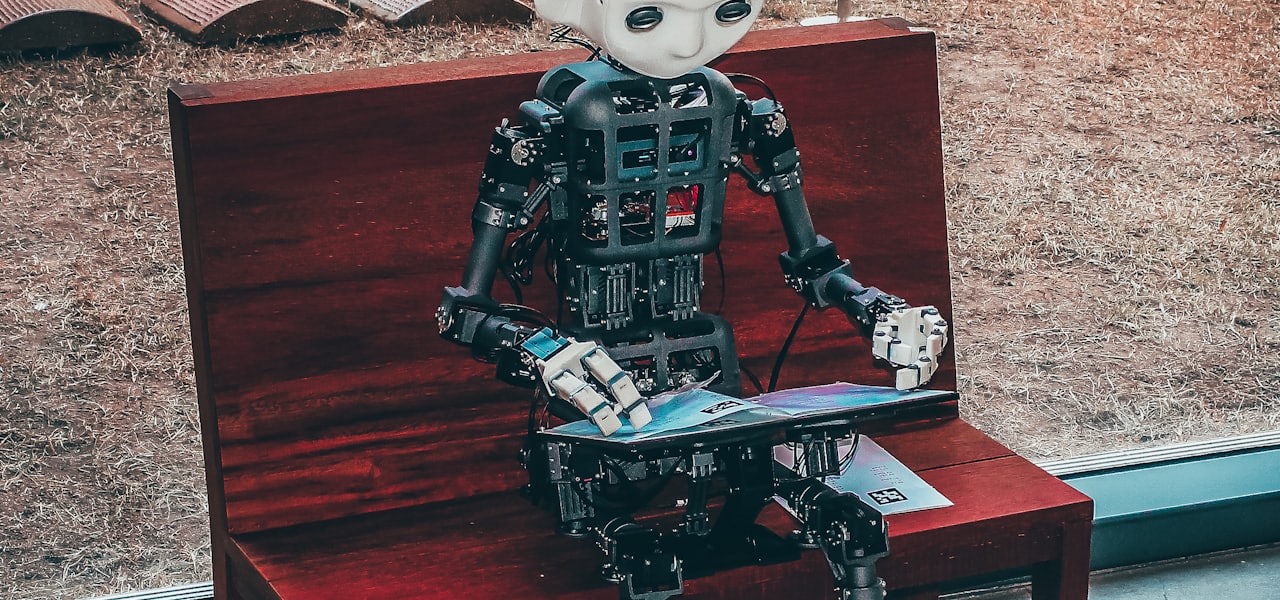
    Robot learning is a research field at the intersection of machine learning and robotics. It studies techniques allowing a robot to acquire novel skills or adapt to its environment through learning algorithms. The embodiment of the robot, situated in a physical embedding, provides at the same time specific difficulties (e.g. high-dimensionality, real time constraints for collecting data and learning) and opportunities for guiding the learning process (e.g. sensorimotor synergies, motor primitives). Example of skills that are targeted by learning algorithms include sensorimotor skills such as locomotion, grasping, active object categorization, as well as interactive skills such as joint manipulation of an object with a human peer, and linguistic skills such as the grounded and situated meaning of human language. Learning can happen either through autonomous self-exploration or through guidance from a human teacher, like for example in robot learning by imitation. Robot learning can be closely related to adaptive control, reinforcement learning as well as developmental robotics which considers the problem of autonomous lifelong acquisition of repertoires of skills. While machine learning is frequently used by computer vision algorithms employed in the context of robotics, these applications are usually not referred to as "robot learning". == Imitation learning == Many research groups are developing techniques where robots learn by imitating. This includes various techniques for learning from demonstration (sometimes also referred to as "programming by demonstration") and observational learning. == Sharing learned skills and knowledge == In Tellex's "Million Object Challenge", the goal is robots that learn how to spot and handle simple items and upload their data to the cloud to allow other robots to analyze and use the information. RoboBrain is a knowledge engine for robots which can be freely accessed by any device wishing to carry out a task. The database gathers new information about tasks as robots perform them, by searching the Internet, interpreting natural language text, images, and videos, object recognition as well as interaction. The project is led by Ashutosh Saxena at Stanford University. RoboEarth is a project that has been described as a "World Wide Web for robots" − it is a network and database repository where robots can share information and learn from each other and a cloud for outsourcing heavy computation tasks. The project brings together researchers from five major universities in Germany, the Netherlands and Spain and is backed by the European Union. Google Research, DeepMind, and Google X have decided to allow their robots share their experiences. == Vision-language-action model == Research groups and companies are developing vision-language-action models, foundation models that allow robotic control through the combination of vision and language. Google DeepMind, Figure AI and Hugging Face are actively working on that.

    Read more →
  • Equalized odds

    Equalized odds

    Equalized odds, also referred to as conditional procedure accuracy equality and disparate mistreatment, is a measure of fairness in machine learning. A classifier satisfies this definition if the subjects in the protected and unprotected groups have equal true positive rate and equal false positive rate, satisfying the formula: P ( R = + | Y = y , A = a ) = P ( R = + | Y = y , A = b ) y ∈ { + , − } ∀ a , b ∈ A {\displaystyle P(R=+|Y=y,A=a)=P(R=+|Y=y,A=b)\quad y\in \{+,-\}\quad \forall a,b\in A} For example, A {\displaystyle A} could be gender, race, or any other characteristics that we want to be free of bias, while Y {\displaystyle Y} would be whether the person is qualified for the degree, and the output R {\displaystyle R} would be the school's decision whether to offer the person to study for the degree. In this context, higher university enrollment rates of African Americans compared to whites with similar test scores might be necessary to fulfill the condition of equalized odds, if the "base rate" of Y {\displaystyle Y} differs between the groups. The concept was originally defined for binary-valued Y {\displaystyle Y} . In 2017, Woodworth et al. generalized the concept further for multiple classes.

    Read more →
  • Snap (computer graphics)

    Snap (computer graphics)

    In computer graphics, snapping allows an object to be easily positioned in alignment with grid lines, guide lines or another object, by causing it to automatically jump to an exact position when the user drags it to the proximity of the desired location. Some CAD software provides a "Snap" pull-down menu with diverse options as preferences for the practice of the operation. In Windows, with the "snap windows" option enabled, snapping a window against the top (or side) edge of the screen causes it to change into full screen (or half-screen for multitasking). Software snapping is analogous to hardware detents which serve to indicate discrete values or steps of an input device.

    Read more →
  • H (company)

    H (company)

    H Company, also known simply as H, is a French artificial intelligence startup which develops "action-oriented" artificial intelligence agents for enterprise automation and productivity. In May 2024, H Company closed a record-setting $220 million seed round, at the time the largest AI raise in Europe. In 2026, H Company released Holo 3, the latest generation of its computer-use AI models. The update marked a major advance in agentic AI, enabling agents to navigate any user interface, interpret screens, and complete complex, multi-step tasks across enterprise systems—much like a human user. This breakthrough positioned H Company at the frontier of computer-use autonomy, accelerating the integration of AI in enterprise workflows. == History == H Company was founded in 2023 in Paris by Laurent Sifre, Charles Kantor, and three DeepMind veterans: Daan Wiestra, Karl Tuyls, Julien Perollat. In May 2024, the firm secured what was then the largest European AI seed round, totaling $220 million led by US investors including Eric Schmidt (former Google CEO), Amazon, and backed by Accel, Bpifrance, UiPath, Eurazeo, Xavier Niel, Yuri Milner, Bernard Arnault, Samsung and others. In August 2024, three cofounders (Wiestra, Tuyls, Perollat) left the company over operational disagreements. In November 2024, H launched Runner H, its first agentic-API platform, which combined a large language model (LLM) and a reduced, 2-billion parameter vision-language model (VLM). In May 2025, H Company acquired Mithril Security, and in June 2025 the company widened its offering for agentic models. In June 2025, Gautier Cloix (formerly CEO Palantir France) replaced Charles Kantor as CEO of H Company, aiming to pivot the company towards a "forward deployed engineers" model. In July 2025, H Company introduced Surfer-H-CLI, an open-source, web-native Chrome agent designed for browser-based automation—able to search, scroll, click, and type on behalf of users and controllable via any visual language model (VLM). When paired with its June 2025 open-sourced 3B-parameter Holo-1 model, Surfer-H-CLI achieved 92.2% WebVoyager benchmark accuracy. == Activity == H Company creates enterprise AI models and agents (agentic AI) to automate and optimize complex workflows. H Company specifically designs AI agents called computer use capable of autonomously interfacing with any software (local or cloud-based) to detect and automate repetitive operations. H Company is based in Paris, France, with international offices in London and New York. H Company raised $220 million since its inception. Gautier Cloix is president and CEO of the company. H Company client include the French national lottery FDJ United. In March 2026, H Company released Holo3, a family of artificial intelligence models designed to operate digital systems by interacting directly with user interfaces. Holo3 enables agents ("virtual humanoids") to understand what is displayed in front-end environments—such as web pages, desktop applications, and other graphical user interfaces—and perform actions such as clicking, typing, and navigating across them to complete multi-step tasks. On the OSWorld-Verified benchmark, Holo3 reportedly achieved about 78.9%, surpassing the scores of OpenAI’s GPT‑5.4 and Anthropic’s Claude Opus 4.6 on this specific test, at roughly one-tenth of the inference cost of these proprietary systems. The release has been presented as a significant step toward automating routine digital workflows, allowing organizations to offload repetitive on-screen work, such as data entry and reconciliation across multiple tools, to AI-based agents.

    Read more →
  • Developmental robotics

    Developmental robotics

    Developmental robotics (DevRob), sometimes called epigenetic robotics, is a scientific field which aims at studying the developmental mechanisms, architectures and constraints that allow lifelong and open-ended learning of new skills and new knowledge in embodied machines. As in human children, learning is expected to be cumulative and of progressively increasing complexity, and to result from self-exploration of the world in combination with social interaction. The typical methodological approach consists in starting from theories of human and animal development elaborated in fields such as developmental psychology, neuroscience, developmental and evolutionary biology, and linguistics, then to formalize and implement them in robots, sometimes exploring extensions or variants of them. The experimentation of those models in robots allows researchers to confront them with reality, and as a consequence, developmental robotics also provides feedback and novel hypotheses on theories of human and animal development. Developmental robotics is related to but differs from evolutionary robotics (ER). ER uses populations of robots that evolve over time, whereas DevRob is interested in how the organization of a single robot's control system develops through experience, over time. DevRob is also related to work done in the domains of robotics and artificial life. == Background == Can a robot learn like a child? Can it learn a variety of new skills and new knowledge unspecified at design time and in a partially unknown and changing environment? How can it discover its body and its relationships with the physical and social environment? How can its cognitive capacities continuously develop without the intervention of an engineer once it is "out of the factory"? What can it learn through natural social interactions with humans? These are the questions at the center of developmental robotics. Alan Turing, as well as a number of other pioneers of cybernetics, already formulated those questions and the general approach in 1950, but it is only since the end of the 20th century that they began to be investigated systematically. Because the concept of adaptive intelligent machines is central to developmental robotics, it has relationships with fields such as artificial intelligence, machine learning, cognitive robotics or computational neuroscience. Yet, while it may reuse some of the techniques elaborated in these fields, it differs from them from many perspectives. It differs from classical artificial intelligence because it does not assume the capability of advanced symbolic reasoning and focuses on embodied and situated sensorimotor and social skills rather than on abstract symbolic problems. It differs from cognitive robotics because it focuses on the processes that allow the formation of cognitive capabilities rather than these capabilities themselves. It differs from computational neuroscience because it focuses on functional modeling of integrated architectures of development and learning. More generally, developmental robotics is uniquely characterized by the following three features: It targets task-independent architectures and learning mechanisms, i.e. the machine/robot has to be able to learn new tasks that are unknown by the engineer; It emphasizes open-ended development and lifelong learning, i.e. the capacity of an organism to acquire continuously novel skills. This should not be understood as a capacity for learning "anything" or even “everything”, but just that the set of skills that is acquired can be infinitely extended at least in some (not all) directions; The complexity of acquired knowledge and skills shall increase (and the increase be controlled) progressively. Developmental robotics emerged at the crossroads of several research communities including embodied artificial intelligence, enactive and dynamical systems cognitive science, connectionism. Starting from the essential idea that learning and development happen as the self-organized result of the dynamical interactions among brains, bodies and their physical and social environment, and trying to understand how this self-organization can be harnessed to provide task-independent lifelong learning of skills of increasing complexity, developmental robotics strongly interacts with fields such as developmental psychology, developmental and cognitive neuroscience, developmental biology (embryology), evolutionary biology, and cognitive linguistics. As many of the theories coming from these sciences are verbal and/or descriptive, this implies a crucial formalization and computational modeling activity in developmental robotics. These computational models are then not only used as ways to explore how to build more versatile and adaptive machines but also as a way to evaluate their coherence and possibly explore alternative explanations for understanding biological development. == Research directions == === Skill domains === Due to the general approach and methodology, developmental robotics projects typically focus on having robots develop the same types of skills as human infants. A first category that is important being investigated is the acquisition of sensorimotor skills. These include the discovery of one's own body, including its structure and dynamics such as hand-eye coordination, locomotion, and interaction with objects as well as tool use, with a particular focus on the discovery and learning of affordances. A second category of skills targeted by developmental robots are social and linguistic skills: the acquisition of simple social behavioural games such as turn-taking, coordinated interaction, lexicons, syntax and grammar, and the grounding of these linguistic skills into sensorimotor skills (sometimes referred as symbol grounding). In parallel, the acquisition of associated cognitive skills are being investigated such as the emergence of the self/non-self distinction, the development of attentional capabilities, of categorization systems and higher-level representations of affordances or social constructs, of the emergence of values, empathy, or theories of mind. === Mechanisms and constraints === The sensorimotor and social spaces in which humans and robot live are so large and complex that only a small part of potentially learnable skills can actually be explored and learnt within a life-time. Thus, mechanisms and constraints are necessary to guide developmental organisms in their development and control of the growth of complexity. There are several important families of these guiding mechanisms and constraints which are studied in developmental robotics, all inspired by human development: Motivational systems, generating internal reward signals that drive exploration and learning, which can be of two main types: extrinsic motivations push robots/organisms to maintain basic specific internal properties such as food and water level, physical integrity, or light (e.g. in phototropic systems); intrinsic motivations push robot to search for novelty, challenge, compression or learning progress per se, thus generating what is sometimes called curiosity-driven learning and exploration, or alternatively active learning and exploration; Social guidance: as humans learn a lot by interacting with their peers, developmental robotics investigates mechanisms that can allow robots to participate to human-like social interaction. By perceiving and interpreting social cues, this may allow robots both to learn from humans (through diverse means such as imitation, emulation, stimulus enhancement, demonstration, etc. ...) and to trigger natural human pedagogy. Thus, social acceptance of developmental robots is also investigated; Statistical inference biases and cumulative knowledge/skill reuse: biases characterizing both representations/encodings and inference mechanisms can typically allow considerable improvement of the efficiency of learning and are thus studied. Related to this, mechanisms allowing to infer new knowledge and acquire new skills by reusing previously learnt structures is also an essential field of study; The properties of embodiment, including geometry, materials, or innate motor primitives/synergies often encoded as dynamical systems, can considerably simplify the acquisition of sensorimotor or social skills, and is sometimes referred as morphological computation. The interaction of these constraints with other constraints is an important axis of investigation; Maturational constraints: In human infants, both the body and the neural system grow progressively, rather than being full-fledged already at birth. This implies, for example, that new degrees of freedom, as well as increases of the volume and resolution of available sensorimotor signals, may appear as learning and development unfold. Transposing these mechanisms in developmental robots, and understanding how it may hinder or on the contrary ease the acquisition of novel complex skills is a central questi

    Read more →